
There are many frameworks and models to assist in all facets of coaching and consulting. One important area I’ve discussed in a recent blog post (linked here) is contracting. Below I will share a “job aid” I created to help with contracting, how it can be used in a coaching engagement, and the types of challenges it would and may not be appropriate for.
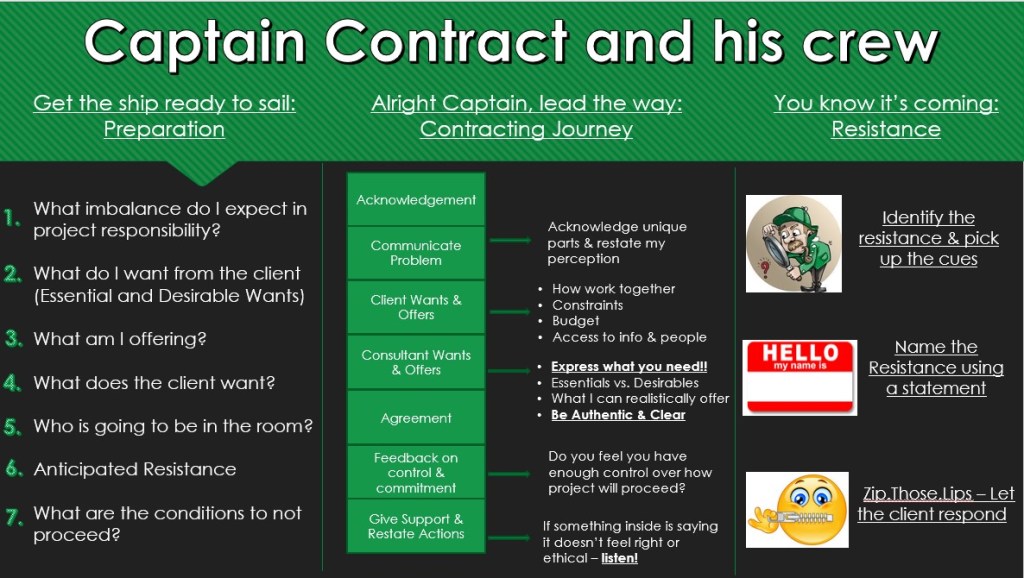
Captain Contract and his crew is meant to show how you can effectively prepare for a meeting so you can contract well, steps to reaching a contract, and how to identify & work with resistance. For the sake of this blog, a contract or contracting is any sort of agreement, verbal or written, between coach and client around goals, boundaries, and how the different parties will work together.
The preparation section has questions to ask yourself before any meeting, whether it is going to be with someone you will coach or leaders from a Fortune 500 business. These questions ranging from who will be in the room, what their and your needs are, and what would make the arrangement a go or no go, require you to put yourself in the other party’s shoes while also thinking about what you want and need. Reflecting like this leads to better readiness and ultimately confidence when the time for contracting arrives.
In the middle, the contracting journey is the steps you take to get to a completed contract. These steps need to happen in a linear manner, although the time needed for each one can vary. For example, you can’t communicate your wants and needs as a coach or consultant until you understand the client’s problems & their needs; however, sometimes the client may clearly outline these for you, while other times you will need to probe with many thoughtful questions to get to the true answer. A point to note, at any time if something inside you is saying something feels off, listen – there could be a nonverbal cue you’re noticing subconsciously or an ethical dilemma you cannot put your finger on right away, but your intuition is usually pretty good!
The third section contains a few pieces of advice when resistance arises…because it always does! It starts with recognizing the cues. If you notice resistance, do not hide from it – name it and call it out because resistance is not a negative reflection on you. Rather, it is the other person’s way of saying they are uncertain or have more questions or have had past experiences that could impact their experience with you. Maybe most importantly, when you ask a question or name the resistance it can be uncomfortable, so our tendency can be to elaborate or keep talking; however, what you need to do can feel excruciatingly difficult: be quiet! Let the other person respond, and this will lead to the dialogue needed to learn from & resolve the resistance.
There are several ways I would use this in coaching. First, I would use it in preparing for an initial meeting with a new client, especially the first two sections. Although I may have limited information about the other person to use for preparation, understanding my needs and boundaries is important. During the meeting, moving through the contracting steps can lead me to see if there is a fit for working together or not. Second, the third column would be useful with a client when there are difficult topics to broach. My tendency is to want to elaborate when I’ve stated honest, yet tough feedback about someone or their resistance, but I need to follow the advice of stating what needs to be said, potentially asking a question, but then zipping my lips.
Finally, there are types of clients and challenges that this tool would be appropriate for & other situations where it would not. I think it would be useful with clients who are having consistent conversations with people they manage or work frequently with outside vendors. However, I believe a client would need to have enough self-awareness about their communication skills and style to effectively employ these strategies. Besides the preparation, these techniques require focusing on someone else’s communication, both verbal and nonverbal, so helping a client understanding their style first would be a precursor for me before coaching them through this job aid.
A client who is still working on recognizing their own communication tendencies, strengths, and weaknesses would not be the ideal person for this job aid. I believe I can use other tools to help them improve their own self-awareness and communication abilities first. Similarly, a type of challenge that this tool would not work for would be diving deeper into resistance, real or perceived. The three tips on resistance do not provide enough substance for someone who struggles to recognize resistance or tends to take it personally. One more challenge where I would not use this tool would be if a client needs help putting themselves in someone else’s shoes or realizing what boundaries they need themselves. The questions in the preparation section will not be helpful if someone cannot answer them effectively, so where figuring these types of questions out is needed, I would go a different route.
Captain Contract and his Crew is an aid to help with contracting, from preparation to the necessary steps to get a completed contract to the resistance along the way. Each part and step can pose its own trials depending on the person and situation. It’s also important to understand that this tool can be impactful with certain types of clients and challenges, but it is not for everyone or every obstacle. Contracting can be the first step of many on the winding, and gratifying, road towards any successful coaching or consulting relationship.
References: Block, P. (2011). Flawless consulting (Third Edition). Pfeiffer.
 Adam Reinhart Digital Portfolio
Leave a comment